The Physics of InAs Quantum Dot Lasers
Lasers incorporating self assembled quantum dot structures, in which the electrons' motion is confined in all three spatial directions, have already demonstrated significant performance advantages over the more conventional quantum well structures.
These include lower threshold current density, reduced temperature dependence, low alpha factor (in fact the alpha factor depends on the operating conditions - spread of carriers in the available states) and the extension of operating wavelength. The advantages of quantum dots lead to their use in applications as diverse as single photon emitters, essential for quantum key distribution, and high power lasers where the increased carrier localisation for example should lead to reduced catastrophic mirror damage. Even with this progress, fundamental behaviour, such as the mechanisms by which carriers distribute themselves among an ensemble of dots and the nature of many body interactions is still being debated and is critical for optimising device performance.
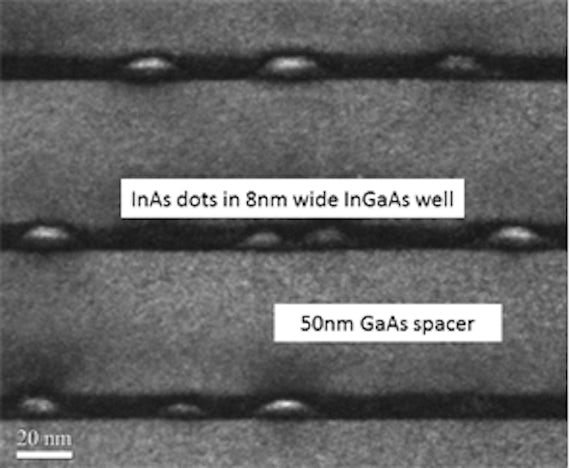
"Self assembled" or "self organised" quantum dots form when highly strained semiconductors grow epitaxially by the Stranski–Krastanow mode, in which 3-dimensional islands are formed after a few monolayers of 2-dimensional, layer-by-layer growth to minimise surface energy. The dimensions of the defect-free islands are of the order of the wavelength of the electron (the de Broglie wavelength), and provide three-dimensional quantum confinement of carriers. In(Ga)As self-organized quantum dots can lead to laser action in the wavelength range 920nm – 1.5µm.

Publications
There was an error in processing data returned back from the API: Unexpected token < in JSON at position 0.
The project team
Project lead

Professor Peter Smowton
Head of School, Physics and Astronomy
Managing Director, Institute for Compound Semiconductors
Condensed Matter and Photonics Group
Team
-

Honorary Distinguished Professor
