
Professor Simon Doyle
Astronomy Instrumentation Group
Cardiff Hub for Astrophysics Research and Technology
- simon.doyle@astro.cf.ac.uk
- +44 (0)29 2087 6170
- N/0.44, Queen's Buildings - North Building, 5 The Parade, Newport Road, Cardiff, CF24 3AA
Overview
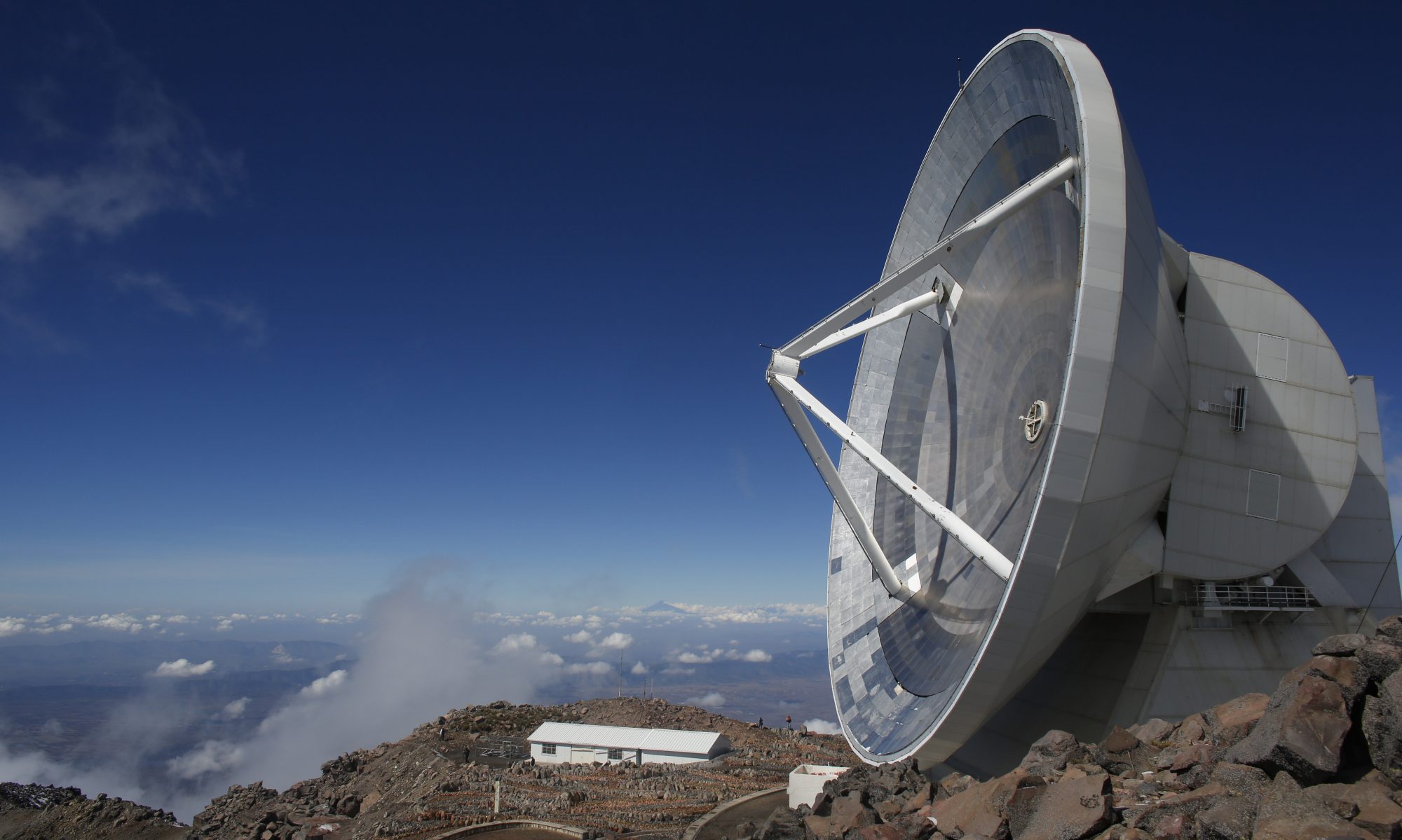
I am a Reader in the School of Physics and Astronomy at Cardiff University specialising in the development of instrumentation for millimetre and sub-millimetre astronomy. Observing at these long wavelengths provides us with a unique view of our Universe but requires highly sensitive and specialised camera systems operated on telescopes located at high altitude (dry) sites or on balloon and satellite-based observatories. Advancing technology in this field includes research and development in superconducting detector technology, superconducting filter-banks and RF signal manipulation, cryogenics, quasi-optical components and filters and end-to-end imaging systems. I am currently the Principal Investigator of the MUSCAT project building a large format millimetre wave camera for the Large Millimetre Wave Telescope (LMT) in Mexico. This is an exciting project that has developed new collaborative links between the UK and Mexican research communities and seen researchers from both countries working together to share knowledge and deliver novel instrumentation capabilities to the LMT.
My work in astronomy instrumentation has also led to commercial applications of my research resulting in the formation of a spin-out company - Sequestim Ltd.
http://muscat.astro.cf.ac.uk/wp-content/uploads/2018/03/cropped-1054917504.jpg
Biography
Academic History 2017 – Present: Reader in Experimental Astrophysics, School of Physics and Astronomy Cardiff University
2015 – 2017: Senior Lecturer, School of Physics and Astronomy Cardiff University
2012 – 2015: Lecturer, School of Physics and Astronomy Cardiff University
2008 – 2012 Postdoctoral Research Associate (PDRA), School of Physics and Astronomy Cardiff University
2004 – 2008 PhD Physics, School of Physics and Astronomy Cardiff University
Education History
2013 – 2014: Modules 1 and 2 of Postgraduate Certificate in Teaching and Learning (PCULT), Cardiff University
2004 – 2008 – PhD student in experimental astrophysics
1999 – 2003: MPhys Astrophysics School of Physics and Astronomy Cardiff University
Teaching and PhD supervision Experience
2012 – Present: PhD Supervisor (6 students to date, three current, three graduated)
2017 – Present: Deputy Module Organiser and primary assessor – MPhys student project module
2013 – Present: Module Organiser – Electromagnetic Radiation Detection
2012 – Present: PhD Co-supervisor (4 students to date)
2012 – Present: Postgraduate lectures
2012 – Present 1st and 2nd year undergraduate tutor (21 students to date)
2013 – Present: BSc project supervisor (8 students to date)
2014 – Present: MPhys project supervisor (4 students to date)
2015 – 2017: Deputy Module Organiser – Astronomy Instrumentation
2013 – 2017: Placement student academic supervisor (4 students)
2012 – 2017: Deputy Module Organiser – Practical Physics
2012 – 2013: Deputy Module Organiser – Electromagnetic Radiation Detection
2008 – 2012: Assistance with BSc and MPhys project students (6 students)
Research funding
STFC 2019 – Present STFC Industrial Partnership Scheme (IPS) “Rapid Airport Security Screening Using Superconducting Technology PI
STFC 2019 – Present SO-UK Phase A PI
STFC 2019 – Present A programme of technology, astrophysics and cosmology in Cardiff – Detector program PI
EPSRC (QUANTIC Hub, Glasgow), Titanium Nitride Kinetic Inductance Detectors for Terahertz Imaging - 2, Cardiff PI 2018-Present
EPSRC (QUANTIC Hub, Glasgow), Titanium Nitride Kinetic Inductance Detectors for Terahertz Imaging, Cardiff PI 2017-2018
RCUK Newton Fund (administered by STFC: “MUSCAT- a new technology large format camera for the Large Millimeter Telescope”. Cardiff PI 2015 - Present
STFC Industrial Partnership Scheme (IPS). “A commercial THz imaging system using Lumped Element Kinetic Inductance Detectors”. PI 2015 - 2018
STFC Consolidated grant: PI on the detectors theme (theme 10) 2016 - 2019
STFC Consolidated grant: PI on the detectors theme (theme 11) 2015 - 2016
SPACEKIDS - EC REA FP7-Space: Senior scientist and work package leader on this grant. 2012 - 2015
STFC Impact Acceleration Account: Co-I on this grant. 2012
School of Physics and Astronomy administrative roles
PCUTL mentor 2015- present
PDRA and Academic staff Mentor 2015 - present
AIG Cleanroom users group representative 2016 - present
Board of Studies member 2012 – Present
Exam Board member 2012 – Present
Postgraduate Admissions Tutor 2014 – Present
Postgraduate progression panel 2016 - present
PhD student interview and selection panel 2012 - present
Membership of external working groups and panels
NIKA Editorial Board 2013 – present
Institute of Physics Low Temperature Group 2012 – 2016
Science organising committee, Science Foundation Ireland MKIDs group. 2016 - Present
Technical advisor to Science Foundation Ireland MKIDs group. 2016 – Present
STFC Detector advisory committee 2018
Roles in external assessment
PhD external examiner, University of Grenoble Alps, France, 2019
STFC Consolidated grant reviewer 2016, 2018
Journal of low temperature physics publication referee 2019, 2016 and 2012
PhD external examiner, Royal Holloway, University of London, 2013
Invited talks and lectures
Seminar talk, Maynooth, March 2015
FISICA workshop, Maynooth, January 2015
Low Temperature Detectors conference, Grenoble 2015 (Invited September 2014)
International Symposium of Space Terahertz Technology - Moscow 2014
Superconducting Devices & Applications, National Physics Laboratories, 2013
Low Temperature Detectors Summer School, Toulon, France, May 2012
Workshop on Microwave spectral polarimetry – Paris 2012
National Astronomy Meeting, Glasgow (not attended due to travel disruption)
Other conference talks, group talks and session chairs
SPACEKIDS concluding presentation to the European Commission, Noordwijk 2016
SPACEKIDs workshop, Noordwijk, 2016
SPACEKIDs workshop, Cardiff 2014
FIRI workshop, London 2013
Public lecture, Cardiff 2013
Low Temperature Detector Conference, Pasadena 2013
Group talk, Jena 2013
Second Keck Institute for Space Studies TiN development workshop, Pasadena 2012
Micro-resonator workshop, Grenoble 2011
First Keck Institute for Space Studies TiN development workshop, Pasadena 2011
SPIE conference, San Diego 2010
Infrared Millimeter and Terahertz Waves (IRMMW-THz), Rome 2010
Session Chair Low Temperature Detectors Conference, Stanford 2009
SPIE conference, Marseille 2008
Superconducting Resonators workshop, Utrecht 2007
Low Temperature Detector Conference, Paris 2007
International Symposium of Space Terahertz Technology Conference, Gothenburg 2007
Ultra low noise detectors workshop, Cambridge 2007
Superconducting Resonators workshop, Pasadena 2006
Publications
We are currently unable to retrieve the list of publications. Visit our institutional repository.Teaching
2020 - Present: Deputy Module Organiser and primary assessor – PX1150 Year 1 Experimental Physics
2017 – Present: Deputy Module Organiser and primary assessor – PX4310 MPhys student project module
2013 – Present: Module Organiser – PX3144 Electromagnetic Radiation Detection
2012 – Present 1st and 2nd year undergraduate tutor
2013 – Present: PX3315 BSc project supervisor
2014 – Present: PX4310 MPhys project supervisor
2015 – 2017: PX4125 Deputy Module Organiser – Astronomy Instrumentation
2013 – 2017: Placement student academic supervisor
2012 – 2017: Deputy Module Organiser – PX2133 Practical Physics
2012 – 2013: Deputy Module Organiser – PX3144 Electromagnetic Radiation Detection
My research focuses on the area of detector and instrument development for millimetre, sub-millimetre and Terahertz imaging for astronomy and commercial applications. Detecting light at the long wavelengths is challenging as most room temperature objects radiate at these wavelengths and that the photon energy is too low to make use of conventional semiconductor based systems such as Charged Coupled Devices (CCDs). Performing sensitive imaging at these long wavelengths therefore requires working at cryogenic temperatures typically below 1K (-272°C) and using novel detector technologies that make use of superconducting material properties to convert light into a measurable output. I lead a group of researchers and technical staff that continues to develop instrumentation and detector arrays based on Kinetic Inductance Detectors as well as new compact continuous sub-Kelvin cryogenic coolers.
Kinetic Inductance Detectors
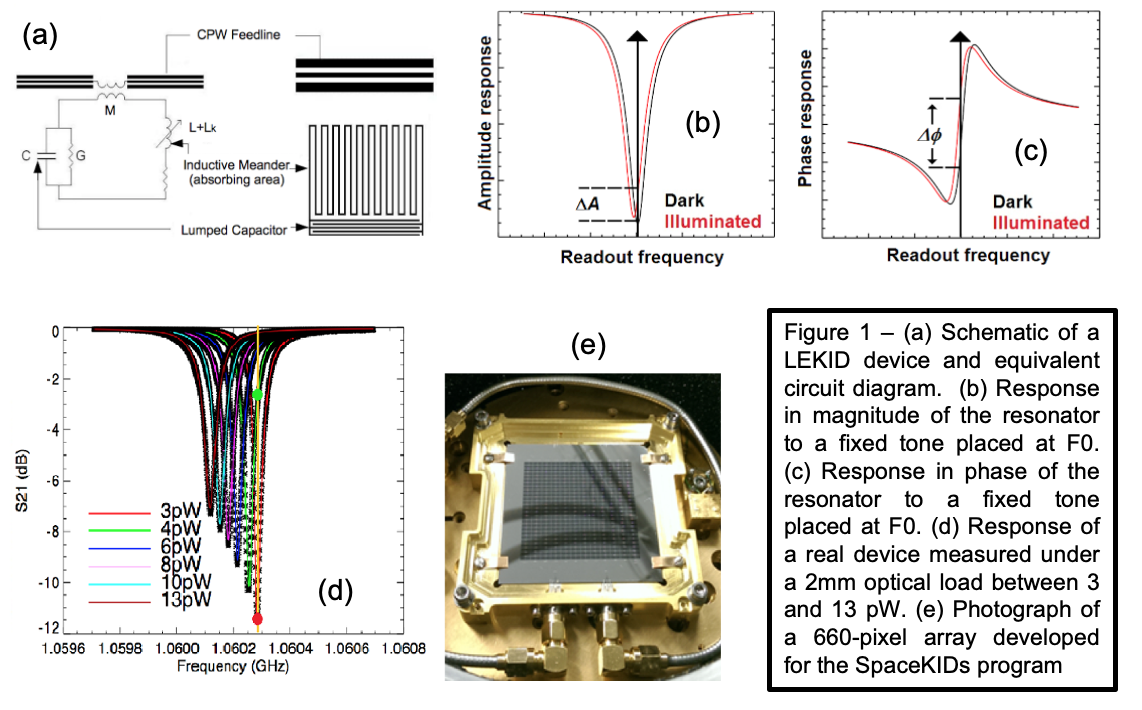
One of the significant outputs of my research has been the invention and development of the Lumped Element Kinetic Inductance Detector (LEKID). This is a variant of the Microwave Kinetic Inductance Detector (MKID) that has properties to enable direct coupling to light (like in a CCD pixel) and convenient coupling to microstrip structures. The LEKID is a superconducting, high quality factor microwave resonator consisting of a planar capacitor-inductor circuit. The inductor has two components – a fixed geometrical inductance Lg and a kinetic inductance Lk resulting in a resonant frequency F0=1/[(Lg+Lk)C]0.5 (typically 0.5-3 GHz). The absorption of a photon with energy greater than the superconducting band gap (hν > 2Δ typically around 90GHz for aluminium based devices) splits paired electrons in the superconducting inductive section modifying F0 though an increase in Lk. This response to absorbed optical power is sensed by measuring the shift in the amplitude and phase of a fixed microwave tone propagated along a microwave feed line to which a LEKID is coupled. This is demonstrated in figure 1.
https://www.astro.cf.ac.uk/~spxsmd/Personal_Page_Figure_1.png
By their very nature, KIDs are naturally multiplexed in the frequency domain and have demonstrated multiplexing ratios of order 1000 detectors/readout channel over readout bandwidths of 2GHz [1]. Furthermore, KID devices only require a single cryogenic amplifier and a pair of coaxial lines to readout each channel leading to a dramatic reduction in the complexity of cryogenic readout electronics and overall focal plane cost compared to rival technologies such as Transition Edge Sensors (TES). KID based focal planes have also demonstrated photon noise limited performance on ground-based mm-wave instruments such as NIKA-2 [2] where the group at Cardiff collaborated on the detector and optical filtering development.
Compact and continuous sub-Kelvin cooling platforms
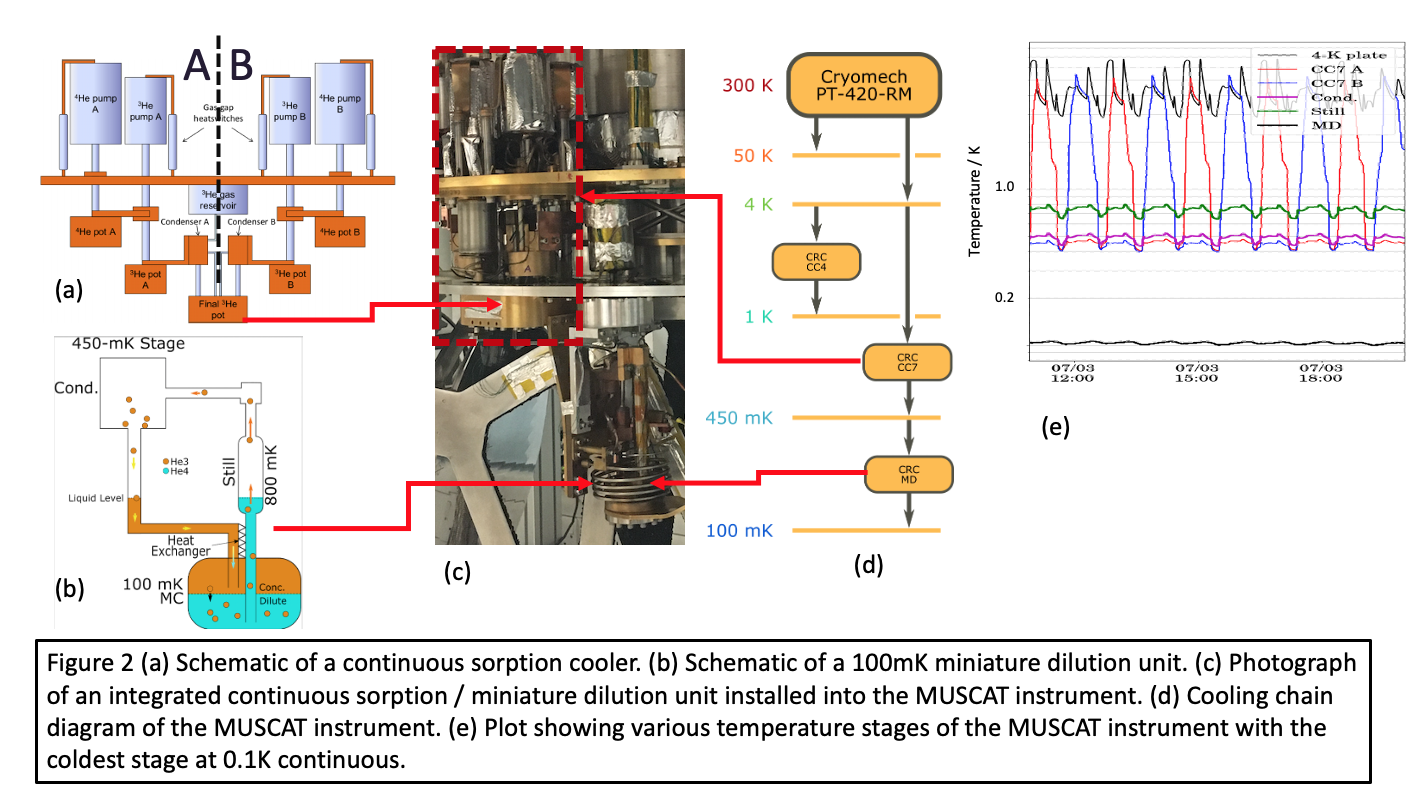
Our group has been working in collaboration with Chase Cryogenics to develop compact and continuous cooling platforms based upon sorption and dilution refrigerator technology. This work has been proven in the MUSCAT instrument where continuous operation at 130mK under an optical load has been achieved continuously in a self-contained system. The principle is that a pair of standard sorption coolers are run sequentially to provide pre-cooling to a miniature dilution refrigerator unit [3]. The miniature dilution unit runs in a similar way to a standard dilution refrigerator but circulation of the Helium-3 is created through a convective effect. Such a system does not require large volumes of costly Helium-3 nor does it require a bulky room temperature gas handling system. The unit is fully automated and has been proven to maintain its base temperature for months at a time. The entire system is pre-cooled with a commercially available Pulse Tube Cooler (PTC) meaning that no liquid cryogens are required, and the entire system can be controlled remotely.
https://www.astro.cf.ac.uk/~spxsmd/Personal_Page_Figure_2.png
MUSCAT – Full Instrument Development
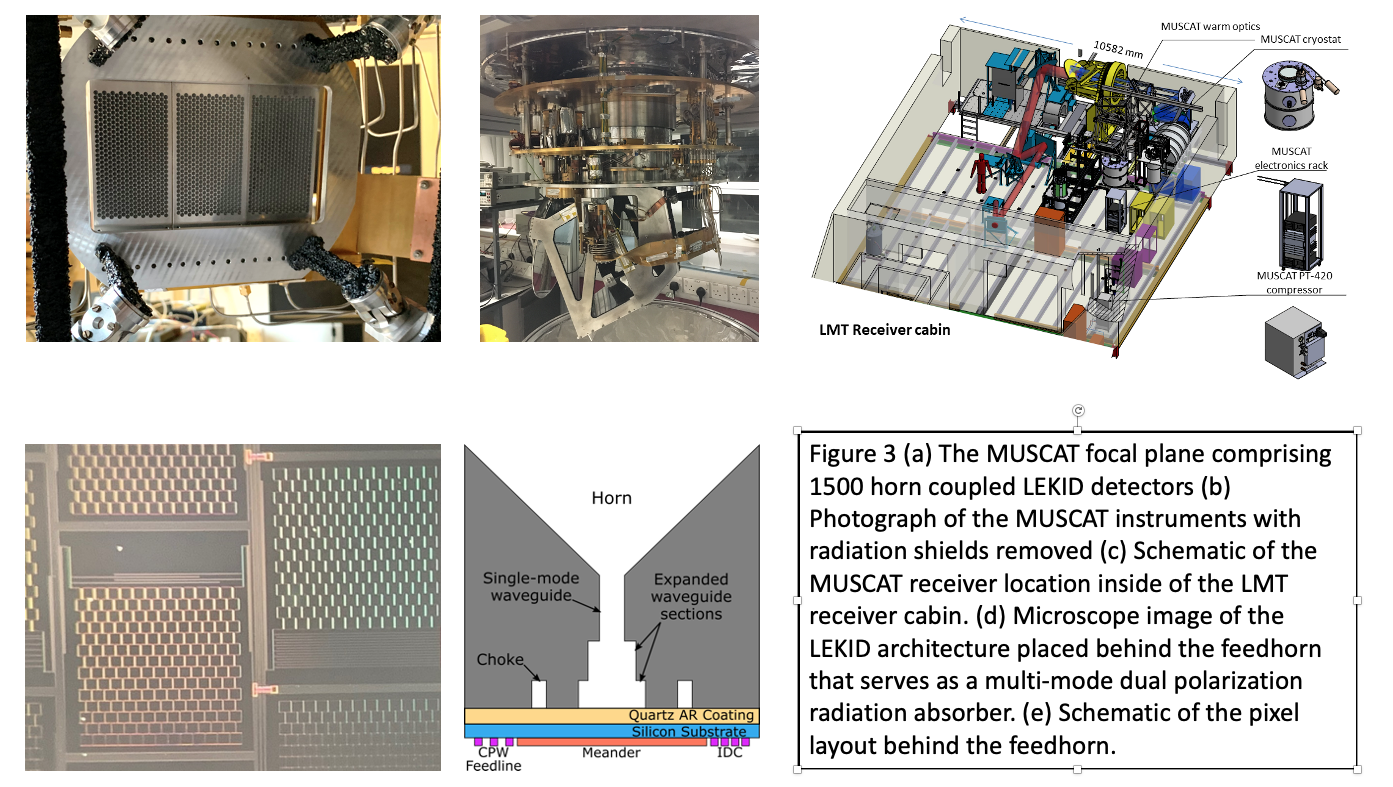
The experience developed in cryogenics and detector design and fabrication has enabled our group to build an end-to-end cryogenic astronomical camera operating at 300GHz (1mm). The Mexico UK Sub-millimetre Camera for Astronomy (MUSCAT) was developed as part of a knowledge exchange program between the UK and Mexico resulting in a full camera being built for installation at the Large Millimeter Telescope (LMT) in Mexico in early 2021. The camera’s focal plane was designed to be simple and cost effected and can be replicated and adapted by our Mexican partners in future configurations. Using the compact and simple cryogenic sub-Kelvin coolers developed by the group means that MUSCAT can be retrofitted with new focal plane technologies and filtering at the site with minimal effort. Ths makes MUSCAT a versatile instrument platform. The Camera is now fully commissioned in the lab and has demonstrated photon noise limited performance meaning the system has reached the fundamental limits in terms of sensitivity. More details about this project can be found here.
https://www.astro.cf.ac.uk/~spxsmd/Personal_Page_Figure_3.png
Imaging systems for industry
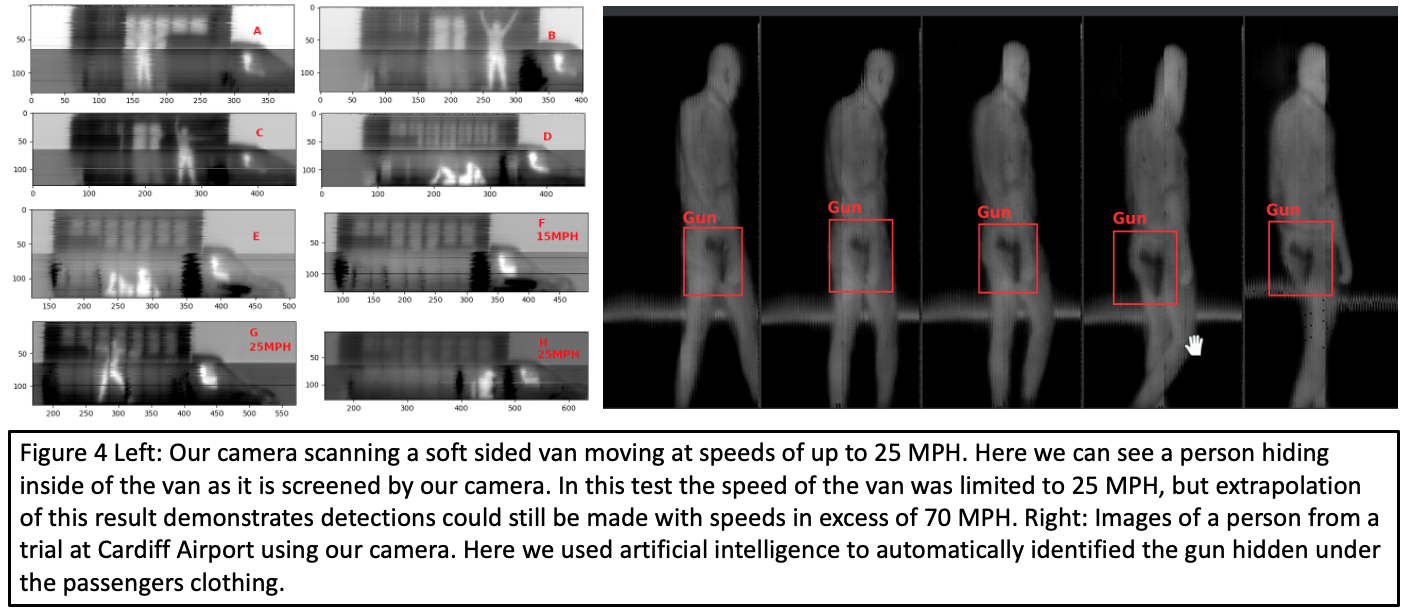
Our group has also worked with a commercial partner Sequestim to produce passive security imaging for airport passenger and goods vehicle screening using the technology developed for astronomy. Many materials including clothing and truck tarpaulins are transparent to millimetre and sub-millimetre light meaning we can detect hidden objects beneath these materials. Importantly, the combination of simplified cryogenics and large format arrays of sensitive detectors makes this approach commercially viable. Another important benefit of this approach is that it is purely passive. Unlike rival systems, our camera does not need to irradiate the object to be screened meaning it is safe for humans and can work at ranges of up to 20 meters. The versatility of such a system means that is can screen people and vehicles on the move, drastically improving security screening times. Further information about Sequestim can be found here.
https://www.astro.cf.ac.uk/~spxsmd/Personal_Page_Figure_4.png
Supervision
Current Students
- Amber Hornsby, PhD student - Cardiff (2016- Present) - Development of Multichroic Polarisation Sensitive Focal Planes for observations of the Cosmic Microwave Background.
- Gethin Robson, PhD student - Cardiff (2020 - Present) - Development of Superconducting Detectors and Filtering Structures for the Next Generation of sub-mm Astronomical Instruments.
Past Students
- Josie Parrianen, PhD student - Cardiff (2014-2018) - Studies of the Limits of Single Photon Detection in Lumped Element Kinetic Inductance Detectors.
- Pete Barry, PhD student - Cardiff (2010-2014) - The Development of SuperSpec; A Fully Integrated On-Chip Spectrometer for Far-Infrared Astronomy.